GitHub Copilot Customization Explained for Beginners: Instructions, Prompt Files, Skills, Agents, and Hooks Introduction If you've recently started using GitHub Copilot, you've probably come across terms like Instructions , Prompt Files , Skills , Agents , and Hooks . At first glance, they all seem to do the same thing—they tell Copilot what to do. So why does GitHub have five different customization features? The answer is simple: each feature solves a different problem. Think of GitHub Copilot as a new developer joining your team. On their first day, you don't just hand them code. You explain your coding standards, give them reusable templates, teach them specialized knowledge, assign them a role, and automate repetitive tasks. That's exactly how GitHub Copilot customization works. In this article, you'll learn what each feature does, when to use it, and how they all work together. By the end, you'll know which feature to start with and which ones can wait un...
Posts
AZURE SQL - Vulnerability Assessment
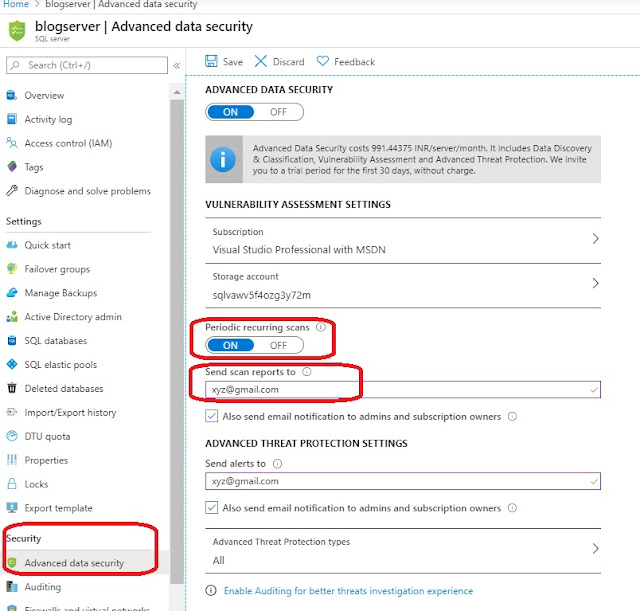
In my last blog post, we looked at the Data Discovery & Classification features within the Advanced Data Security (ADS) offering for Azure SQL. In this blog post, we will have a look into Vulnerability assessment. Azure SQL Overview Azure SQL Database is a fully managed Platform as a Service (PaaS) Database Engine that handles most of the database management functions such as upgrading, patching, backups, and monitoring without user involvement. As with any database platform, security remains a top concern to address this issue or concerns Microsoft have offering called Advanced Data Security with Azure SQL service. Pre-requisites Enable Advanced Data Security (ADS) at the database level by navigating to Settings > Advanced Data Security for your SQL database and click Enable . Alternatively, ADS can also be configured and managed at the server level by navigating to Settings > Advanced Data Security for your server and switching the ‘Advanced Data Security’ ...
AZURE SQL - DATA DISCOVERY & CLASSIFICATION
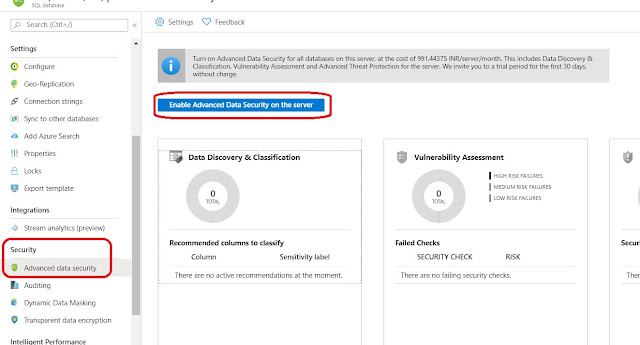
Azure SQL Overview Azure SQL Database is a fully managed Platform as a Service (PaaS) Database Engine that handles most of the database management functions such as upgrading, patching, backups, and monitoring without user involvement. As with any database platform, security remains a top concern to address this issue or concerns Microsoft have offering called Advanced Data Security with Azure SQL service. Pre-requisites Enable Advanced Data Security (ADS) at the database level by navigating to Settings > Advanced Data Security for your SQL database and click Enable . Alternatively, ADS can also be configured and managed at the server level by navigating to Settings > Advanced Data Security for your server and switching the ‘Advanced Data Security’ setting from ‘Off’ to ‘On’. AdventureWorksLT database will be used. Enable the Auditing settings to have complete investigation experience. Go to the Auditing blade and toggle Auditing switch from OFF to ON. Choose...
Azure WebJob - configurable Cron Expression
Azure WebJobs is a feature of Azure App Service that enables you to run a program or script in the same context as a web app, API app, or mobile app. Azure WebJob are ideal for running long running background tasks in cloud. There are 2 types of web job: Continuous web job Triggered web job Manual triggered web job Scheduled triggered web job Scheduled triggered WebJob will be executed based on provided CRON expression.The scheduling is done with a TimerTrigger that takes in a cron expression as argument as shown below public async Task TimerTriggerFunction ([TimerTrigger( "0 */5 * * * *" , RunOnStartup = true )] TimerInfo timerInfo, CancellationToken cancellationToken) { //Some logic goes here... _demo.SomeAction(); } Above code snippet shows CRON expression which is scheduled run every 5 minutes. Which is absolutely fine but when you are building enterprise grade solution we want job to be flexible enough to r...